



Микроконтроллеры движут следующую волну Edge AI
До недавнего времени machine learning — и даже deep learning — считался прерогативой мощных серверов, с training и inference handled by gateways, edge servers, или data centers. That view held потому что shift toward distributing computation between cloud и edge был ещё nascent. Сегодня breakthroughs от индустрии и академии сдвинули эту парадигму.
Consequently, high-performance processors delivering trillions of operations per second (TOPS) no longer a prerequisite for ML workloads. Modern microcontrollers, many equipped with dedicated ML accelerators, now bring intelligent inference directly to edge devices.
These controllers execute ML tasks efficiently, at minimal cost и power, connecting to cloud only when needed. In essence, microcontrollers with embedded ML accelerators mark the next leap в endowing sensors — microphones, cameras, environmental monitors — with on-device intelligence, the cornerstone of the IoT value chain.
How deep is the edge?
The edge commonly defined as farthest point from cloud in an IoT network, often represented by an advanced gateway или edge server. In reality, edge terminates at the sensors themselves — those positioned close to the end user. It is therefore logical to embed as much analytics as possible directly within those sensors, a role for which microcontrollers are perfectly suited.
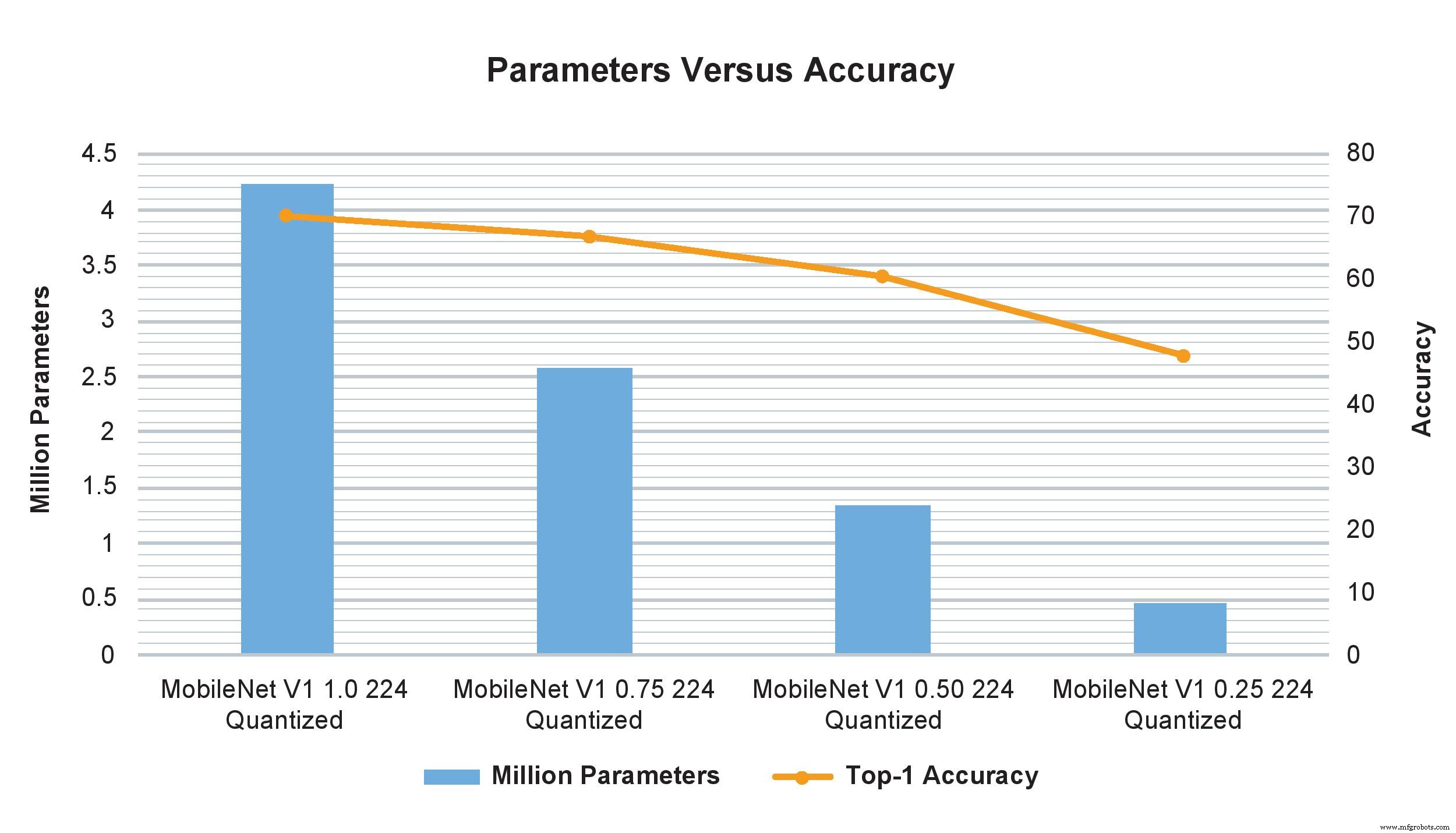
Single-board computers can indeed perform edge processing, delivering impressive performance и, when clustered, approaching small-scale supercomputers. Yet they remain too bulky и expensive для thousands of units demanded by large-scale deployments. Moreover, they require external DC power — often unavailable in constrained environments — whereas an MCU draws only milliwatts и can operate on coin-cell batteries или a few solar cells.
Consequently, the field of microcontroller-based edge ML — known as TinyML — has exploded in popularity. TinyML aims to enable inference, и eventually training, on small, low-power, resource-constrained devices, particularly microcontrollers, instead of relying on larger platforms or the cloud. This necessitates compact neural-network models that fit within limited processing, storage, и bandwidth budgets while preserving performance.
Resource-optimized models enable devices to capture adequate sensor data for their tasks while fine-tuning accuracy и reducing resource demands. Consequently, although some data may still be transmitted — directly to cloud или via an edge gateway — the volume is significantly lower because preliminary analysis has already been executed on the device.
A common TinyML use case is a camera-based object-detection system that can capture high-resolution images yet faces limited storage, necessitating resolution reduction. With on-device analytics, the camera captures only the objects of interest, preserving higher resolution for the selected frames. This level of functionality — once reserved for powerful hardware — is now achievable on microcontrollers thanks to TinyML.
Small but mighty
Although TinyML is a nascent field, it already delivers impressive inference — и increasingly, training — performance on modest microcontrollers, with negligible accuracy loss. Recent successes span voice и facial recognition, voice-command natural-language processing, и simultaneous execution of multiple sophisticated vision algorithms.
Practically, a microcontroller priced under $2, featuring a 500-MHz Arm Cortex-M7 core и 28 KB–128 KB of memory, can deliver the performance necessary to render sensors truly intelligent.
Even at this cost, such microcontrollers incorporate robust security features (AES-128), support multiple external memory types, Ethernet, USB, SPI, и interfaces for a range of sensors, including Bluetooth, Wi-Fi, SPDIF, и I²C audio. A modest price increase typically yields a 1-GHz Cortex-M7, 400-MHz Cortex-M4, 2 MB of RAM, и graphics acceleration, all while drawing only a few milliamps from a 3.3 V supply.
A few words about TOPS
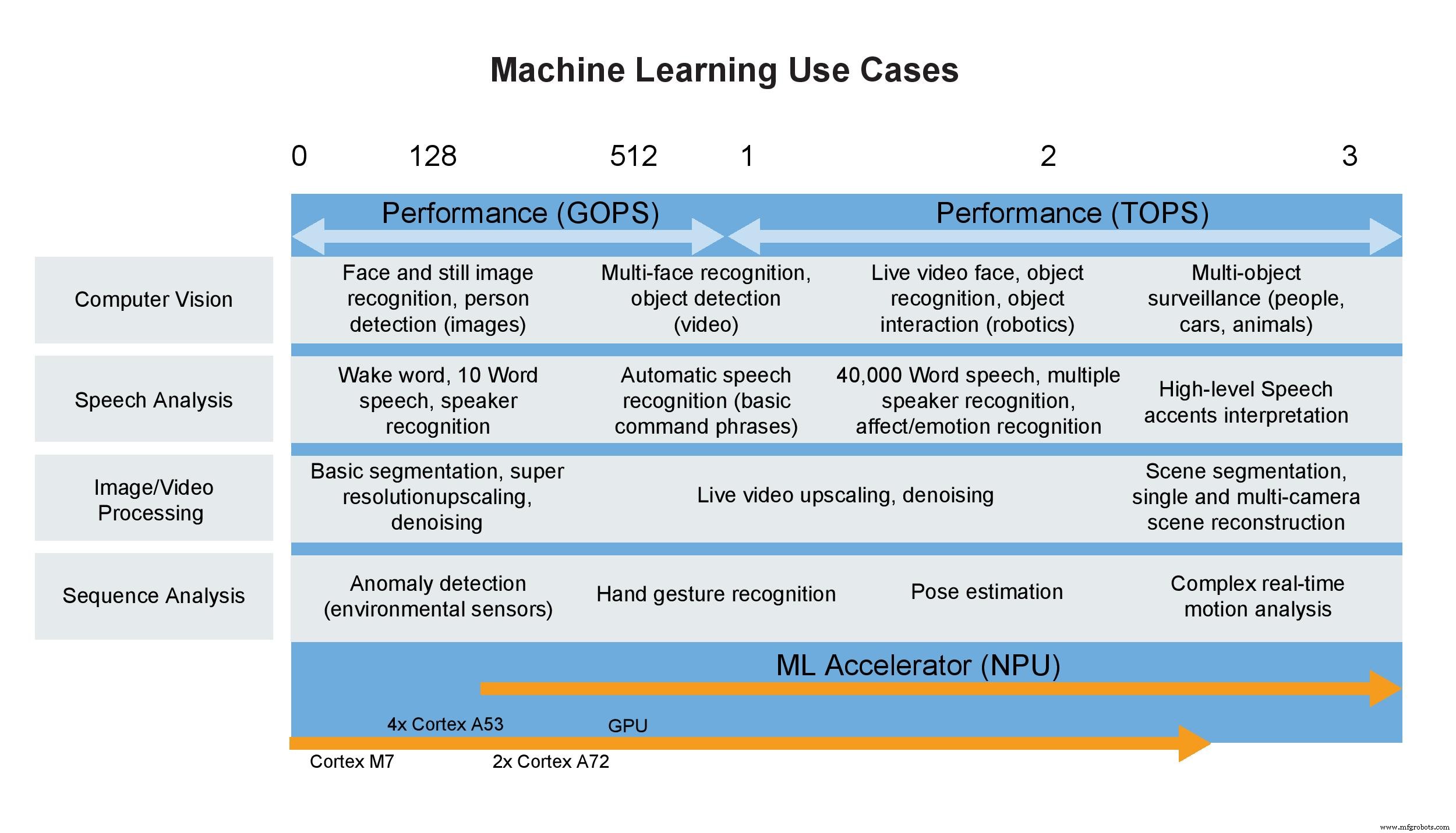
Manufacturers often benchmark neural-network accelerators using a single metric — trillions of operations per second (TOPS). While attractive, this figure can be misleading. It reflects raw computational capacity in a controlled lab setting и ignores practical constraints such as memory bandwidth, CPU overhead, и data pre- and post-processing. In real deployments, the achievable throughput can be 50–60% of the advertised TOPS value.
Moreover, for microcontrollers, which typically offer only 1–3 TOPS, the metric is even less informative. The real power of these tiny devices lies in their tightly integrated Arm Cortex processors, support for integer и floating-point operations, и the ability to run inference engines like TensorFlow Lite with minimal footprint.
Conclusion
The push to run inference directly on or adjacent to sensors — whether still or video cameras — is accelerating as the IoT ecosystem moves toward edge-centric processing. Rapid advances in microcontroller-level neural-network accelerators are consolidating AI functionality with application processors without a dramatic rise in power consumption or size. Models trained on powerful CPUs or GPUs can be slimmed with TensorFlow Lite и deployed to microcontrollers, scaling effortlessly to meet growing ML demands. Soon, even training will be feasible on these devices, positioning microcontrollers as formidable competitors to larger, costlier systems.
>> Эта статья изначально опубликована на нашем партнёрском сайте EE Times.
Встроенный
- Как облачные вычисления топлива инновации ИИ и повышают бизнес‑эффективность
- Как встроенные системы двигают инновации в современном автомобиле
- Охлаждение парообразовательной камерой: растущее решение для высокотемпературной электроники
- RF энергосбор движет экспансию AI-питаемых беспроводных приложений
- Растущая роль USB-C в управлении питанием для носимых и мобильных устройств
- Murata и Google представляют минимальный Edge TPU ИИ-модуль: 4 TOPS в чипе 10×15×1,5 мм
- ECM3532: первая интегрированная ультра‑низкоэнергозатратная ИИ‑сенсорная плата Eta Compute ускоряет Edge‑разработку
- ADLINK запускает NEON‑1000‑MDX: готовое Edge AI умное камеру для быстрого внедрения промышленного зрения
- Роботы движут будущее Индустрии 4.0 на NPE
- Как периферийные вычисления революционизируют коммерческие развертывания IoT